Showing posts with label writing. Show all posts

Sunday, October 1, 2017

Black dogs.

I continue to be busy. I'm working and taking care of Buddy and going to TMS 5-days a week during work hours. It's been a lot. 

The weather has been unseasonably warm in Montreal, so the fall is only starting to make an appearance. 

I've been thinking about how I'd like to write about black dogs as a theme. I read a memoir called Killing the Black Dog, apparenly the black dog is a metaphor for depression. 

I find it an odd metaphor, since for me black dogs have always been symbols of companionship and familiarity, since every dog I've ever had was black. A black labrador retriever, a black schnauzer and now with Buddy, a black pug. 

The labrador, a confirmation of my fragility and the cruelty of life.

The schnauzer, a crescendo of anxiety and tumultuous happenings.

The pug, an acceptance of the absurd and an attempt to move on. 

Depression to me may feel like a fog that creeps into the brain and covers me like a cloud. Or an evil spirit that feeds off of my energy, joy and ambition. I don't think a representation of depression in popular culture has ever been as spot-on as Dementors in the Harry Potter universe. 

TMS has been going well. The appointments break-up my day. After the first week and a half, I felt my brain to be less cluttered and "cloudy" feeling. Less foggy. It's like there was this density and weight I couldn't see past, and it lifted. I would imagine it to be similar to feeling congested, except without being centrally focused in the sinuses. It's also similar to being sleep-deprived. 

The doctor at the TMS/neurology lab also wants me to be tested for sleep apnea, since I'm perpetually exhausted. I'll be doing that this upcoming Friday. 

If TMS continues to go well (I'm about half-way through the 4-6 week treatment) I may experiment with lowering my anti-depressant dossage, and see if it helps with my energy levels and sleep. 

TMS isn't invassive. It's a time commitment and a hassle to get to, but it's covered by medicare. I think one American I read about having done it paid for it out of pocket and he said it cost him roughly 15 grand. SO, I thank my lucky stars for Canadian healthcare because that's the entirety of my savings for a downpayment. For a treatment that may or maynot help me. 

The treatment itself is a little odd. You sit in a chair, not unlike a dentist chair, lean back, and a large flat thing is put on your head. It's places on your frontal lobe area and then you get tapped on the head. That's basically it. It send you magnetic pulses that feel like being tapped on the head by a woodpecker with a blunt beak. Tap tap tap, 5 seconds, beep, tap tap tap and so on. 

After a few sessions I started falling asleep. It's not painful, just weird and hard to ignore. Some times the magnetic pulses must be stronger, because sometimes it's harder for me to fall asleep since I really feel them, and they make my eye and nose twitch. Other times I feel like a cat leaning into a scratch and barely feel them, but it's comforting. 

I think about writing a lot, I just don't want to spend more time in front of a computer. In a few months time I may start working from home a day a week, in which case I could set aside a little bit of time on that one day a week to write. We'll see. 

I'll definitely keep updating about TMS, since I myself came to it through online blogs and personal accounts, and there's very little out there about it. 

Monday, May 1, 2017

Diana Athill.

From Write, Never Marry, and Other Love Advice from Simone de Beauvoir's Editor: An interview with acclaimed writer and editor Diana Athill shortly after her 99th birthday.
I really began to write entirely as a healing exercise. I didn't realize that, but that first book I wrote came out of the blue, a good many years after my unhappiness. I had been living carefully enough, working at a very interesting job, having lots of friends. But all during that time, I do know that if I stopped and looked at myself and said, "What is my life?," I would have said to myself, "It is a life of failure." Simply because I'd grown up in a family and at a time when my job was to get married and have children, and I had failed. There was this underlying thing of failure deeply buried. I didn't sit down and say, "I'm going to write that book." It happened. It was a very uncanny experience, and it came easily. And when it was finished, I was healed.
The interview is by Anya Raza, check it out. Athill is 99 and sharp as shit. Goals!

Friday, April 7, 2017

Outrunning depression.

Great piece by Kim McLarin on depression, race and all manner of interconnection.

OUTRUNNING ESHU: ON FINALLY SEEKING TREATMENT FOR DEPRESSION

Some highlights for me:

On "mental illness" as a white category which alienates communities of colour:
Mental illness, mental disorder of any possible stripe, was definitely white folks’ mess. White people had nervous breakdowns; black folks just got tired of shit. White people had anxiety, black folks had nerves. Black folks got the blues sometimes, but only white people got clinically depressed. White people listened to Prozac. Black folks listened to their mother, their pastor, and God.
Some stats:
In 2014, an estimated 15.7 million adults (6.7 percent of the adult population) experienced at least one major depressive episode, according to the National Institute of Mental Health. A major depressive episode is defined as a period of two weeks or longer during which a person experiences depression, loss of interest or pleasure in everyday life, and at least four other symptoms that reflect a change in functioning: sleeplessness or excessive sleeping, loss of appetite, or problems with energy, concentration or self-image. (An important note: the NIMH did not make exclusions for depression caused by bereavement, substance abuse, or medical illness.) 
Women are 70 percent more likely than men to experience depression in their lifetime, says the CDC. On the bright side, depression among women improves after age 60, which is not true of men. 
Not surprisingly, people living below the poverty level are more than twice as likely to experience depression as those living at or above the poverty line.
An estimated 92 percent of African-American men with depression do not seek help, according to the CDC. Which makes it reasonable to consider the statistics off.
On what we know and highlighting how much we don't know:
I try to meditate. Psychological research, including a 2014 JAMA Internal Medicine analysis of forty-seven studies, suggests that meditation and mindfulness-based cognitive therapy can be moderately effective in treating depression and perhaps more so at preventing relapse. Then again, psychological research (a 2015 meta-analysis published in the journal Science) suggests that 60 percent of psychological research is, essentially, crap.
On the fear of sad people, and the reminders present in the melancholia of others:
The deep American suspicion of melancholy and its contents is connected to the deep American suspicion of intellect, of complexity of thought and perspective, of wakefulness.
On writers, creatives and depression:
Not all writers are tortured geniuses. I know many stable writers, levelheaded and content, writers who don’t drink or take drugs or require antidepressants, writers who use, without irony, words like “optimist.”
Still, there’s no denying some subtle connection between creativity and mental anguish. Several studies have confirmed the link (Andresen, 1987; Jamison, 1989; Ludwig, 1995) even if they fail to explain it. The largest study to date to examine the connection was conducted by researchers at the Karolinska Institute in Sweden. That study found that creative types, writers in particular, were overrepresented among people with schizophrenia, depression, bipolar disorder, anxiety syndrome, and substance abuse problems. Writers were also almost twice as likely to commit suicide as the general population.
Are we sensitive, thus we need to express creatively or is our need to look at things and think deeply, responsible for our melancholia?
The great Japanese filmmaker Akira Kurosawa famously said, “To be an artist means never to avert one’s eyes.” How much toll does it take to not look away? Ecclesiastes says: “And I set my mind to know wisdom and to know madness and folly; I realized that this also is striving after wind. Because in much wisdom there is much grief, and increasing knowledge results in increasing pain.”
On "molecular residue":
But there’s even more than that. I am fascinated by (what I can understand of) the exploding field of behavioral epigenetics, which posits that the experiences of our recent ancestors leave molecular residue which adheres to their DNA— and therefore to ours. In other words, not just physical but psychological and even behavioral tendencies really can be inherited. If your grandmother or even your great-grandmother struggled with depression because she escaped from the Holocaust, or narrowly avoided a massacre in My Lai, or was enslaved and raped repeatedly or watched her father being lynched—or was simply neglected and unloved during childhood—it matters to you and in you. Whether you know it or not.
I gotta admit, when I was in my late teens and early 20's I  had this foreboding reoccurring thought that my sadness was karma. I must have been a terrible, monstrous shit in another life. Like researching philosophy and religion, it was an attempt at explaining why I felt the way I felt.

Read the entirety of McLarin's piece of you can.

Wednesday, January 11, 2017

Links on writing.

Like most of my creative pursuits, I'm always scolding myself for not making more time to write. Over the course of the last few months, I've bookmarked various articles and links on writing, so I thought I'd share them here, for my future self, as well as anybody else who might be interested.

I think of all the reading I've done, memoirs have been the most transformational for me. It's let my mind wander into considering my own story. It's helped me open up to the possibility that my own stories are worth telling.

I don't consider myself a writer, but I would like to some day.

The Best Writing Advice of 2016

33 Authors Gave Us Their Best Advice On Writing
Ignore all lists of writing tips. Including this one. And including this tip. Or at least take them with a big pinch of salt. I have never met two writers who work exactly the same way: One of the hardest, but ultimately most rewarding, things about writing is that you have to work out for yourself who and what you are as a writer, and how you yourself work best. When you’re starting out, it’s very easy to see a piece of advice by [insert your favourite author here] and think, If s/he writes like this, I must do it that way too. That can be unhelpful, and instead I think that every time you hear a writing tip, you have to decide whether it means something to you, resonates with you, or whether it sounds like the stupidest thing you’ve ever heard. It’s your book, you need to learn to write it your way. Now please ignore this advice. 
– Marcus Sedgwick
I also have the following lists:

10 Outstanding Short Stories to Read in 2017 

The Most Moving Personal Essays You Needed To Read In 2016

Enjoy!

Friday, December 16, 2016

David Foster Wallace and depression.

From a piece on David Foster Wallace and his depression:
All of this is to say that sadness doesn’t possess the real teeth of depression. The symptom that distinguishes depression from any other state is something I would call terminal fragility, although it’s defined in a less hand-wavey way by the DSM as “guilt/worthlessness.” It’s the feeling that the world’s fundamental malignancy begins with oneself. It represents a categorical change in the way you perceive negative outcomes. You see pain as appropriate punishment, instead of occasional inconvenience. You see yourself as a burden—a net loss for humanity—somehow less worthy of life. Instead of thinking, “that shitty day happened to me,” you think, “as is consistent with my deservedly shitty life, that shitty day occurred, the pain of which is unmitigated by its predictability.” The normal thought, if your hair is misbehaving, is, “fuck, I’ve gotta buy a blow dryer.” The depressed thought is, “I am feeling paralyzing woe because my hair, finally, is as ugly as my soul.” That’s depression’s foremost distinction—it holds you responsible for your suffering.
The original article, The David Foster Wallace Disease by Sasha Chapin is over on Hazlitt.
Wallace’s story “The Depressed Person” opens like this:
“The depressed person was in terrible and unceasing emotional pain, and the impossibility of sharing or articulating this pain was itself a component of the pain and a contributing factor in its essential horror.”
I've never read Wallace. It sounds too intense for me. Intellectually and in scope. I don't know that I have the stamina or attention span for it. I also don't know that reading such well-developed writing on and around depression would be good for me. I'm already convinced, brother.

Friday, December 9, 2016

The pendulum swings.

I've thought about it, and I doubt I'll be applying to graduate school.

Though K really inspired me, once I researched the programs in Montreal, the costs, and the intellectual limitations and rigid guidelines, I got real tired real quick.

My issue with graduate school is that there's so much stuff you have to do in order to do what you want to be doing. Required classes and lectures and work groups. And though I'm sure masters-level theory and research method courses can be very helpful, I also know they most likely are not.

I struggled a lot with my undergraduate thesis because it wasn't about my research, it was about checking off boxes and making sure the i's were dotted and the t's were crossed.

If the majority of the work I'm doing now is creative, thinking of reformulating any of it in order to adhere to ivory-tower standards bummed me out.

I'm not getting a master's degree in order to go up a pay scale as an engineer. I'm a fucking art-bum. Why pay so much for a degree; kill myself for something that has such limited application - when art itself exists well outside of official spaces.

What I'm doing now, trying to write, creating small pieces for Etsy - I did it for me. I do this for me. I need to let stuff out. I need to try and let stuff out, I am encouraged by people's reception of my work - all of this, all of this is for me.

I worry about compromising what it is I want to do for something so fickle. I have a tremendous amount of respect for education, for reading and the arts, for history and engaged critique. But now I also know that that doesn't necessarily live in institutions, and in fact, the halls of academia have been exclusionary than anything else.

Even "mad studies" lives within specific kinds of academic spaces. Spaces you need to pay a price of admission to access. Spaces where your language use and classwork is filtered through a professor's narrative. From my reading of the faculty websites, I don't see flexibility or radicalism here.

I do not want to spend the time I have, the little bodily energy I have and the intellectual and creative energy I have trying so hard to fit into another system that wasn't meant for me.

Let me be clear when I say "wasn't meant for me" I do not mean that this space was destined for specifics kinds of people of which I am not. I mean it isn't meant for anyone, really. It's meant for very specific kinds of knowledge and exchange. There is a given look to what the pursuit of knowledge is, and it looks like a research paper. It looks like deadlines and exams. It's impersonal and cold. And making it anything other than these things is work. Work for myself. Work that is undervalued and patronized.

I don't want to live in that space. I want more free time for my own creative endeavors. I want very little of anything else.

I want to explore things fully, through my own whims, not through pre-set paths off of school hallways.

Monday, December 5, 2016

Mad studies.

I had a busy weekend. On Saturday I trekked out to Victoriaville to visit a handful of antique places with K. I was introduced to K in Victoria when I visited my buddy there. K is in Montreal now, working on a master's degree in interdisciplinary studies, specifically disability studies.

Our day together had us discuss all sorts of things, much of it around disability studies, academia, access, mental illness, graduate work and just everything in and around those subjects.

When I talked to her about my Etsy shop, as well as my blog here, and what I focus on she was very encouraging as to my work being elaborated into graduate work.

She also pointed to an upcoming symposium on feminism and dark humor, as well as the field of "mad studies." Both things seemed so me. 

I'm going through a few "mad studies" links now:

This is a resource site. It seems to be based in Lancaster but many of the links are Canadian. It seems to have started in Canada.

It's linked me to the Centre for the study of Gender, Social Inequities and Mental Health in Vancouver, which sounds right up my alley.

From The Guardian UK, Mad studies brings a voice of sanity to psychiatry by Peter Beresford:
The approach embodied in mad studies offers us a coherent roadmap for rethinking our mental wellbeing by recognising people who have experience of mental distress as both service users and experts.
I'm surprised that with all the reading I've been doing I've not been linked to Ryerson or "mad studies" before today. The symposium was in 2012. Though in all fairness to me in 2012 I was too busy having panic attacks to be reading anything other than Ativan labels.

 From another article, The rise of Mad Studies: A new academic discipline challenges our ideas of what it means to be “sane” by Alex Gillis:
"Mad studies doesn’t reject medical models of madness [but it puts] them into a historical trajectory, one that shows that psychiatry isn’t an absolute interpretation of human mental states,” says Kathryn Church, an associate professor of sociology and director of Ryerson’s school of disability studies.
It contextualizes "madness" - and I hope the representation of actual "mad" voices and experience fill the gaps (and there are many) of the nuances of access, care, and experience. Like any history account, the majority of reading someone's history means negating the histories of others. Views are never fully three-dimensional. Much of our talk about mental health is extremely superficial.

The article ends with a call to represent yourself and your experience, and that's where I'm wading right now.

How best to represent myself and my experiences?

Is academia more limiting than it is a helpful framework?

Do I want limits to how I represent myself and my struggles?

Am I comfortable with a language-based approach?

Does my writing and creative work need to be shared, viewed, and recognized to be valuable?

Am I willing to make such a financial sacrifice, for a degree with no monetary return value?

Am I willing to continue living like a student / someone who is perpetually broke?

Can I afford graduate school?

Do I have the energy for it?

All things I'm thinking of. All of this, and more, of course.

Thursday, December 1, 2016

Lidia Yuknavitch's The Small Backs of Children.

Where are the borders of art? 
Where are the borders of a woman's body?
How unimaginable is one without the other?
When we think of violence, are we not aware, as women, of our place within the world of men?
The borders of our body, of our safe spaces, of hostile spaces?

I just finished reading The Small Backs of Children by Lidia Yuknavitch and I am re-committed to my impression of her as a fluid, visceral representation of what it is to write of art, trauma, violence and living a woman's experience.

I was floored when I read her memoir, The Chronology of Water. It's lead me here, to her novel, which kept me as enamored.

It's a novel, yes, but I feel as though the narrative of people and places is secondary to the passages that describe life so astutely. This book features a group of friends, all artists and creators, juxtaposed to a young girl in eastern Europe, orphaned by war and surviving through art, grit, and the persistence of young blood.

There are segments of her book that discuss art and experience, art as expression, as language, as reference point, as both anchor and catalyst. These sections created in me more questions. An infinite amount. Sometimes they fuse with and of the body, and gender and sexuality pour into her writing. Violence as commonplace, as a masculine language and threat. She has a similar juncture in violence, trauma, and women's bodies. One intrinsically stomped onto the other.

Our blood is all over this world.

Our greatest threat is so linked to us.

And of trauma, of death and loss and surviving the horrific, does our tongue split, now able to speak two languages? As if at different frequencies, two languages in parallel.

Yes I understand your desire for me to print this document, to do this grocery shopping, to celebrate this holiday, but do you understand that feeling, the deep rumble that comes from prolonged, wretched pain, where you become diluted by the incessancy of it, and become convinced your threshold makes you the undead, untouchable. Have you known that pain? No? Then we do not speak the same language. But yes, I do enjoy coffee. And yes, the weather has improved.

From page 69:
Who are we in moments of crisis or despair? Do we become deeper, truer selves, or life up and away from self, untethered from regular meanings like moths suddenly drawn toward heat or light? Are we better people when someone might  be dying, and if so, why? Are we weaker, or stronger? Are we beautiful, or abject? Serious, or cartoon? Do we secretly long for death to remind us we are alive?
This actually heavily links to the conversations I've been having with my best friend S regarding HBO's Westworld. There is an awful lot to unpack regarding the nature of trauma. If you have not watched Westworld - do not read anything about it! I went in blind and was able to discover and discuss things as I went and it's been very interesting!

Are our trauma's our cornerstones? 

I'd read something recently about the way in which trauma can root certain pathways in the brain, making it more difficult to adapt or change habits. Isn't this a scientific explanation for what we already know? How our wounds remind us, how old habits die hard? Aren't we creatures of narrative, of story? Isn't the story we hear most often our own?

Yuknavitch also has these really bodied moments, that represent those abstract experiences of being alive and sentient but not fully present in our culture and context. Detached. From page 93:
Then he thinks: love is an abstract word coming from a face hole.
I guess the only alienating bit to Lidia's novel is how it's populated by successful artists. Confident in their art. Monied. That's my alien experience. My unknown. Where art is a work, a calling, and not a form of communication and a way of being, of purging that is necessary.

Friday, August 12, 2016

Lidia Yuknavitch interview.

The Lenny newsletter this week has an interview with Lidia Yuknavitch, whom I love, and whose book the Chronology of Water reached me, and moved me. Mainly because she was using language I understood in a way I'd never experienced before. 

Her interview with Suleika Jaouad is great, I'm basically re-posting most of it here:
Suleika Jaouad: In The Chronology of Water, you wrote: “Aspiration gets stuck in some people. It’s difficult to think yes. Or up.” When did that absence of hope hit you the hardest? 
Lidia Yuknavitch: When my daughter died on the day she was born, a traditional definition of hope was sucked out of my body. I’m not saying I’m proud of this, but it just happened. For me, what became important was learning to breathe again in a way that used regular air. The word aspiration has a breathing sense to it. It dawned on me that we have to breathe and to find reasons to stay alive on our own terms. Sometimes that doesn’t come from what we’ve been told our whole lives. 
I believe in art the way other people believe in God. I’m not trying to make a tricky sentence. It’s just true. I have found reasons to breathe again by living in communities of people who choose self-expression over self-destruction. It’s another way to form hope, without hierarchizing it so that you’re looking up toward a God, or someone smarter or more famous than you are. It’s a lateral definition of hope where you just need each other, and you need to stand up and not leave each other hanging. 
SJ: I think a lot about how much pressure there is to be someone who “suffers well.” There’s a mythology surrounding the “survivor’s story” that can be inspiring to some but can make others feel like they’re suffering the wrong way. 
LY: Boy, I hate that narrative so hard, to be honest. The truth is, suffering sucks and it can take you to a place of wanting to kill yourself, and there’s nothing beautiful about that. Suffering is not beautiful. Suffering, from my point of view, is about a real place in a real body where you face the other side of living. How you choose to understand that story probably determines how you’re going to live the rest of your life. I feel kindred with fellow sufferers, and I don’t ever want to romanticize the story of suffering, because then you’re just playing into making it a good story or a sellable story for a culture. 
SJ: You write with so much rawness and honesty about your life, but I’m interested in the experiences you touch on but choose not to delve into, like the specifics of your father’s abuse and your relationship to drugs and alcohol. How do you decide what to write and not write about? 
LY: You don’t have to read very far into my writing to find those things, but you won’t find them literally represented. There’s no scene of actual sexual abuse by my father in my writing. On the other hand, that sort of paternal sexual violence is threaded through every word I write. It’s as if it’s in the language. It’s in my habit of being. It’s a structure of my consciousness. 
You don’t have to always name the explicitness or literalness of a thing to represent the essence of it to a reader or listener. That’s the reason poetry works and it’s the reason painting works. It’s not explicit. It’s figurative, and it gives you the whole soul-body experience without naming it in a literal sentence. I think the work of art is to push for that so that the reader feels it in their body to be true, whether or not the explicit sentence is there. That’s how I work with material, but I am filled with respect and enthusiasm for people who also represent it explicitly. 
SJ: I think of you as someone who rejects tidy narratives and who doesn’t seem to care about the rules. I’m curious about where your outlaw spirit comes from. 
LY: If there’s one phrase that I should probably tattoo on my forehead it is this: “I’m not the story you made of me.” The more people I can convince to hold that mantra, the more I’ll have been of good use in my life. We don’t have to accept the stories we inherit, the ones that tell us who we’re supposed to be. We can stand up and say no at any point, even if we’ve been saying yes our entire lives. It’s never too late. We can always reject the story placed on top of us, and we can always revise and destroy one story and restore another. It’s a never-ending possibility. 
SJ: What are your best words of advice for fellow misfits and aspiring writers? 
LY: I’m trying to help us remember that we invent our own beauty and our own paths and our own crooked, weird ways of doing things, but that they’re not nothing and they matter, too. We’re the half of culture that doesn’t take the paths that are sitting right in front of us. Our song may be a little off-key, but it’s a kind of beauty, too. I know I’m not the person who thought that up, and I’m not the person who invented that as a truth, but I can sure stand up and help remind us not to give up, that we have a song, too.
She's someone I look up to. She's survived and she's living off her art. That's as much of a win as one can hope for. As I could ever hope for.

Tuesday, July 26, 2016

Mental health 'zines.

Dazed has a piece up on mental health 'zines worth checking out. 

I've been thinking a lot about taking my creative time more seriously, about really putting in the time and the word, so exploring ways in which I can write, design and illustrate is something that's been on my mind.

Buddies of mine have been making 'zines forever, it just never really clicked with me.

Seeing such amazing work makes me reconsider what it is I can really accomplish through 'zine making. Sharing my stories in a really personal way might be good for me.

I was especially drawn to shit's fucked. 


The illustrations are beautiful.

I'm checking out the site that sells it. I might order a few. Check it out!

Things are weird with me lately! I feel like I,m in a haze! I don't know what's going on! I feel like I need a good re-centring.

Any recommendations?

Thursday, June 30, 2016

On Virginia Woolf.

I've been reading Virginia Woolf's Moments of Being, and it's been moving. Well, parts of it have. There are long segments that list names of lords and ladies, parties and calling cards. I resolve those dry sections to be equivalent to me telling anybody about my day, it would be tedious. Our days are filled with people and happenings of no real value outside of propelling our story forward. It seems only the peaks and valleys really make their mark. So I am drawn to Virginia most when she is lost in thought.

I've not read the interpretations of her, the forewords and notes, I want only to read what's written by her hand. I've been working my way through her work, and I've been increasingly drawn to her voice.

She describes concepts in a way that speaks directly to me.

She mentions "ancestral dread," (68) how she feels she's inherited the puritanical from her ancestors. She also briefly mentions what sounds like a sexual molestation, and the shame she feels in recognising her beauty, or even looking at herself. She's quick to move away from this, and focuses instead on her feelings of always having been older than herself.

During difficult times, I've often felt my depression was deserved. Inherited. That maybe it was a past life, manifest. Maybe I was fucking awful once. Maybe my people were. I'm white - that's likely historically accurate. Maybe I inherited this pain from someone. Maybe it's my birthright. This ancestral dread, is another way to externalise the depression, to name it. It's a demon. A curse. An ancestral dread.

She also names how much of our time is spent in a state of  "non-being" (70).  These, the parts of our day we don't really recall due to monotony and habit. These moments we move from one place to another, as automatons. "Every day includes much more non-being than being," she says, from over 70 years ago. Now we experience that non-being with a screen in our face. But it's easier than that. It takes so much energy to focus. It takes so much to be alert, to be active. It comes in bursts. Now like then.

She describes her depression as only a writer can:
"But it was not over, for that night in the bath the dumb horror came over me. Again I had that hopeless sadness; the collapse I have described before; as if I were passive under some sledge-hammer blow; exposed to a whole avalanche pf meaning that had heaped itself up and discharged itself upon me, unprotected, with nothing to ward it off, so that I huddled up at my end of the bath, motionless." (78)
 "The dumb horror" is indeed what it is. No doubt her use of the word "dumb" is meant in a dumbing sense, meaning temporarily unable to speak or communicate. And that would be an apt description. Both work, really. There's a cutting into you that disables the parts of you that communicate, that reach out. There's also a return to more rudimentary processing, more immediate and needs-based. I liken it to being sleep-deprived. There's a real pull you can't just "snap out of," no matter how hard you fight it.

Overall the read got long at times, Woolf goes over the social nature of 20th century England in a way that's exhausting to even imagine. Did these people have jobs? They're mainly aristocrats, so no, they didn't.

Woolf is best when she floats above the world, not when she's bogged down by social-decorum and the daily "non-being."

Friday, May 20, 2016

The suicide memoir.

Over on Lit Hub, from The Suicide Memoir: True Crime, Mystery and Grief, Al Alvarez quoted discussing Sylvia Plath's suicide:

“It was an act she felt she had a right to as a grown woman and a free agent.”
Oooof. First, when I write "ooof" imagine someone being punched in the stomach.It's the sound someone makes blowing out air after being sucker-punched in the gut.

Many things can bring you to suicide. Desperation. Pain. Fear. But ultimately we should all have an unquestioned right to our own bodies, so yes, suicide is a right. 

Sunday, April 24, 2016

Luck and Ladybugs.

Every spring it happens. What seems like hundreds of ladybugs emerge from some crack or crevice in my house. For a week or so they gather near windows so I open screens and doors to shoo them out. Sometimes I take a small piece of cardboard, usually a business card or an advertisement and scoop them up gently, plopping them into a little cup. I make my rounds and then go outside and shake them free. Sometimes they fly away, sometimes the just fall to the ground. Sometimes their movements are slow, their wing-covers a dry brown. Other-times they're quick and bright and I struggle to understand how they survived the winter tucked away in our house.

I also find some dead. Dried-out on window sills and along the floor. Sometimes I see them huddled in corners of the ceiling where I can't reach them. I can't help them there. We don't speak the same language so there's no use in calling out to them.

The other day was a bad day. I wasn't entirely myself. I was a half-person. Despondent and exhausted. And instead of collecting these ladybugs and setting them free, I removed them from my space through the rumble and suction of my vacuum cleaner.

For three of them, that's how they left this house. On any other day, they would have left differently.

But on that day, luck was not with them.

Yesterday I did some cleaning, and throughout the day I pushed these little ladybugs into a cup, or into my hand where I would lightly close my fist, keeping them from flying away  I would make my way outside and open my hand, shaking it over the garden.

And today, I do the same.

But that one day, I did not. That one day, they were unlucky.

Wednesday, March 23, 2016

The suicide note as literary genre.

Lit Hub has a piece up, The Suicide Note as Literary Genre. The author only focuses on literary heavyweights, like Virginia Woolf, whose note, like all of her writing is morose and distantly powerful:
Everything has gone for me but the certainty of your goodness. I can’t go on spoiling your life any longer. I don’t think two people could have been happier than we have been. 
There's no real discussion of suicide as an act of desperation and pain, it's framed through the value of literary voices and of their written legacy. What Woolf is saying is not unlike any other "normal" suicide note, she's saying her partner is too good for her, and that she feels she's ruining their life, and that she was indeed happy with them, but that it needs to end for her now. She can't anymore.

He author ends his piece saying:
It is little wonder, then, that there are those of us who read and return to the literature of suicide with interest, and always with a sense of gratitude, an awareness of embattled courage. No matter how often I read them, it still seems an incredible thing to have laid words upon a void, to have given raiment even to expiration.
Raiment, or dressing that "expiration" in language only romanticizes it. A painter can represent a harrowing, isolate landscape and it can be truly beautiful to look at and ponder, but to live there is a horror. And in some art, there is an amount of exploitation. A photographer takes a picture of a war zone, of an absolute horror scene that someone is living through, and that piece of work will represent that horror for better or for worse. That photographer cannot claim responsibility for the way in which that photograph is interpreted. They can, however claim their intent. In the case of this piece on suicide notes as literature, the author does have a very romantic view of these pieces as literature first, and as a pained expression second.

That's not to say that there is no literary value to suicide notes, there can be. But for me, the context within which they were created cannot be extruded from the resulting literary output.

Having "given raiment even to expiration" is a pretty turn of phrase for something more plainly expressed by saying the writers of these suicide notes used their art, and their main communication tool - writing - to express their despair and attempt to explain their actions to those left behind.

I don't know, the piece bugs me. I think it's fucked up to overly enjoy this kind of writing, especially from a non-depression based reading. If you're mentally ill, reading a suicide note can evoke a lot of feelings in you, and it can be helpful in describing your own pain or experience if language isn't your forte. It's also speaking at a pitch that I recognize.

Overly "fetishizing" this writing is fucked up and seems disrespectful to me. The author is quick to point out that criticism and then dismiss it, but it's valid. These are intimate pieces written for specific people, mind your business. He writes about it with glee. It bugs me.

Friday, January 22, 2016

Falling forward through time.

I haven't been able to bring myself to write lately. It just seems like time has been slipping away from me. Work has been busier, which makes a huge difference. I can usually read online and fart around creatively when I'm waiting on work. I've also been pretty tired in the evenings. I've been trying to cook a lot, and cook healthy, fresh foods, so that takes up more of my time. I've also been pretty social, if I plan something on Saturdays and Sundays, it's as if I lose all free time. 

This month has flown by. My birthday is in early January, and it's usually a not-great time for me. I'm trying to learn to celebrate that I'm still alive, and that people care about me, but for years it's always been a disappointment. My birthday is right after the holidays, people are broke and tired. I end up feeling my birthday is an inconvenience and is easily ignored or forgotten.

In roughly two weeks I'll be going out to BC to visit my friend C. Dr. Rishi has recommended I plan something for myself to look forward to, so I am, indeed, looking forward to it. It's be a nice mental break. It'll be good to see C and her new house. It'll be good to take in the sea and the area. I scheduled a small tattoo for myself of one of my illustrations (already paid for). Most importantly of all, I paid for the ticket with air miles. I don't have a grand to spend on a ticket. Not when I'm trying to save up to buy something.

So I'm going to BC. It might be nice to be somewhere else. To walk around. To breathe different air. To see a friend. To chat. To cuddle a dog. It's also warmer there, significantly. She's on Vancouver Island, so there's some kind of magical micro-climate there. For example it's 10°C where she lives right now and it's -6°C here.

I'm reading The Visiting Privilege by Joy Williams right now and there's this short story that moves through time and it's just beautiful and stirring. It took me a while to warm up to her book, some of the stories are very removed and are written with distance. But some, like The Excursion really fascinated me. The New York Times describes her as "one of the greatest chroniclers of humanity’s insignificance." Reading that clicked her work into place for me.
In Williams’s precise, unsparing, surprising prose, her characters reach for the sublime but often fall miserably to earth: ‘‘Sam and Elizabeth met as people usually meet. Suddenly, there was a deceptive light in the darkness. A light that blackly reminded the lonely of the darkness.’’ She has a gift for sentences whose unsettling turns — ‘‘While she was thinking of something perfectly balanced and amusing to say, the baby was born’’ — force readers to grapple, just as her characters grapple, with the way life will do what it wants with you.
Her work is so removed, so unsentimental.
Joy Williams likes a good road trip, so let’s take one through a Joy Williams story. The road is familiar — you recognize the religious undertones; the dark humor; the animals flapping overhead and squashed on the pavement. You smile at Williams’s disarming manner of juxtaposing words, pressing unsettling meanings out of them: ‘‘The two women sat in the living room surrounded by wooden ducks. The ducks, exquisite and oppressive, nested on every surface.’’ You think you know the route you’re taking, but after a few detours and hairpin turns you may have lost track of how you’re ever supposed to get to where you’re meant to go. The ride might end with the squeal of brakes and shattering of glass. It might also be beautiful: 
The car flipped over twice, miraculously righted itself and skidded back onto the road, the roof and fenders crushed. ... None of them were injured and at first they denied that anything unusual had happened at all. May said, ‘‘I thought it was just a dream, so I kept on going.’’
This is it. This type of removed way she writes about brutal, daily life, and how the absurd and the routine are lined up against that brutality and how narrative moves through them both so effortlessly. There is no real relationship to the characters. Her stories are intentionally alienating, which is something I haven't experienced before.

Her work really presents my own disassociation to me. Moving through memory and present time, through wants and dreams and should's and have to's.

I'm asking myself a lot of questions lately, but I'm also attempting to swallow my need for patience. I need to make decisions. To prepare. To choose one option over another, and reading Williams' makes it all seem less important. Less permanent.

That's the mirror she's created. We're impermanent, and at a glance, we're often absurd and hard to understand. In some moments, we're genius. At other times, we're the worst. And when sweetness presents itself, it's a glorious treat.

Tuesday, January 19, 2016

just what you need to hear today.

Great piece by Jamie Lauren Keiles called just what you need to hear today. Please take a look.

She has this great project called Depressiongrams. She says a lot of interesting things about artistry and depression, it's a great piece.

Jamie is on twitter, I started following her after reading this piece, you should to!

You can also check out more of her writing on her website.

Friday, January 8, 2016

Looking back, a little.

I haven't taken the time to write much since the traumatizing amnesia-based hospital visit. It's been updates here and there, and some minor posts, but I've found approaching the subject daunting.

In truth, it's also writing I'm finding difficult. Namely, translating the way my thoughts wander and wonder to narrative that's structured. On any given day I have these flashes of a place I can explore through writing but I'm often unable to take the time-out needed to write it down, or I'm quickly distracted by something else.

Over the holidays I often thought of taking out my laptop and taking the time to write something, but I was just so exhausted. Most of the holiday vacation was spent with family, cooking and partaking in Christmas parties. Then I went home around the 28th and just slept a lot and did my best to re-cooperate from the stress and exhaustion of the amnesia scare which was compacted by then going back to work.

Before I knew it, I was back to work on January 4th. My birthday was yesterday (the 7th), so focus quickly turned to my birthday. And now, in a month's time, I'll be visiting my friend out in Victoria, so my mind is occupied with planning and research. I'm also just looking forward to being away.

Last night I had dinner with my mother and my friend J. She came by the restaurant after work, and we had a drink and some good food. We were able to talk about my mom and catch up. She travels a lot for work, so it can be difficult to see one another. She's also a social butterfly and has a very active social life, so we don't hang out in the same circles anymore. She and I went to high school together. She's still friends with a lot of the guys who trigger some stuff in me that I'm still working on. We stayed friends even though I don't see the other guys.

I'm now 32. I don't really care that much about the number. I did find entering my 30's difficult, because all of a sudden the expectations of maturity and success seem increasingly important. This feeling was well described in an article I recently read in The Atlantic:
Being a Millennial and trying to adult is wildly disorienting. I can't figure out if I'm supposed to start a non-profit, get another degree, develop a wildly profitable entrepreneurial venture, or somehow travel the world and make it look effortless online. Mostly it just looks like taking a job that won't ever pay off my student debt in a field that is not the one that I studied. Then, if I hold myself to the traditional ideal of what it means to be an adult, I'm also not nailing it. I am unmarried, and not settled into a long term, financially stable career. Recognizing that I'm holding myself to an unrealistic standard considering the economic climate and the fact that dating as a Millennial is exhausting, it's unfair to judge myself, but I confess I fall into the trap of comparison often enough. Sometimes because I simply desire those things for myself, and sometimes because Instagram.
On most days I am resolute in knowing the things I don't want so I'm able to stand in my choices. I think the major difficulty for me is the guilt and shame I have of "losing my 20's" - that comes with a kind of mourning. I woke up 30, with little to show for myself in terms of social life, career or romance. My body was a mess. My heart and mind were traumatized, and I had to learn how to manage myself and live in my life. Even though I don't want what some want, and I don't value what some value, it can be difficult to feel zero judgement from self or other.

My birthday has been secondary to the amnesia scare. Seeing my mother disoriented, and initially fearing a stroke or alzheimer's really put me on my ass. My initial fear-reaction was that she was going to die, and that I was now "officially" alone. What if I would have had to be her caregiver? Would I have been able to cope? 

I know this is a normal fear. I feel though, that for me, and for folks who are socially withdrawn or struggling with mental/health issues it's just, more. The well-adjusted people in my life have partners. They have friends. They have plans. They have careers. Savings. I'm not quite there yet. My living at home has kept me in this child-like, dependent space. This experience highlighted my desire to have my own space, so that when my mother passes, my home doesn't fall apart. But, it also got she and I talking about what she wants, and what her fears are. Would she be more comfortable in a duplex with me? Separate but close? We both need to assess what we want, and talk about it.

I feel like 2016 is going to be a big year. There will be a lot of movement. For now I'm still tired and trying to take care of myself as best I can. Being in the emergency room with my mother for nearly 24 hours violently shook the importance of health into me. I'm trying to take things one day at a time, and am really trying to focus on taking care of myself from a kinder, more loving space.

Tuesday, December 1, 2015

I'm a wittle sick baby.

I went to bed with wet hair (not unusual) and woke up with a sore throat. I think I have a cold. I'm not too bad, per se, I'm just slightly sick. So far.

My barometer is pretty high, since throughout university and then art school every winter break I would get strep throat, with the exception of the year I got pneumonia. It's always my throat (blame it on bulimia) and it's usually when vacation time comes around and I try to relax.

I went to bed early last night and watched a few episodes of Jessica Jones and then passed out. I've been taking echinacea, so hopefully I can avoid a full-out sickness thing. I also got the flu shot this year, so ideally I'll avoid that shit show. I can't afford to miss that much work. Nothing is actually happening at work, I just can't afford it.

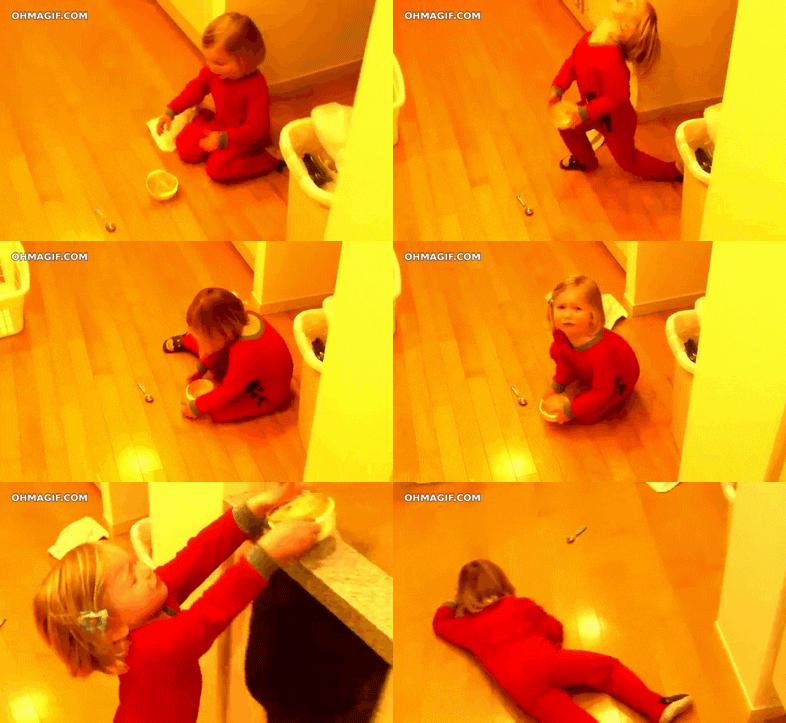
It just takes so much energy to stay "on top of" trying to take care of myself that whenever I hit a snag, I feel like a useless baby. You know when you see a baby get so frustrated over something seemingly tiny? I feel like that. I drop a paper clip, and it's like, WHY DOES LIFE HATE ME SO MUCH.


funny cute girl bowl mixed

Especially lately, with Christmas less than a month away, I have a lot more outgoing money and I am poor to the max. My credit card is maxed out. Living pay-check to pay-check right now is not pretty. There's a lot more of that transferring-over-4$-to-my-credit-card-because-it's-better-than-nothing kind of thing going on.

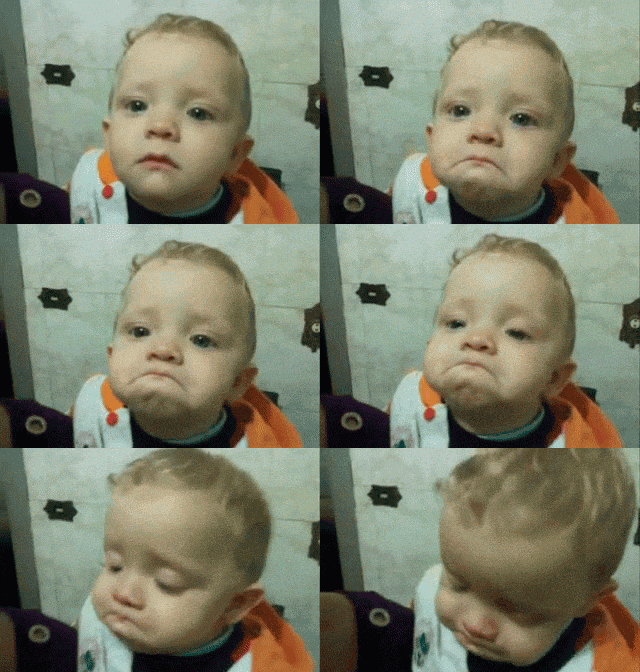
I just feel useless.

When I interact with other humans I know, I just wanna lay around and have people talk to me like a baby. I have no energy. Once home I just want to go to bed. If I were on my own right now I'd just be eating toast three times a day.


In 3 weeks, I'll have paid off my loan. In January I'll begin putting money aside in liquid/accessible form, so I can save up for a couch and major appliances. I should need at least 5,000$. So I'll have a small down-payment, and money for costs. Ideally I'll be able to line everything up for this spring/summer. If I put away 200$ a pay-check, I'd have 2,200$ for May 2016. 

Ideally I'd be able to add whatever tax return I get to that. What does that give me? 3 grand? Still not enough. I guess I can get a place and wait to get a couch. Christ.

sad baby upset disappointed frown

So, that's "the plan" for now. It's a plan. I just wish I had been better with money sooner, instead of pissing my 20's away wishing I was dead. Didn't really set myself up for an established 30-something-life.

I'm trying to walk up a hill, and seeing people whiz by me, and I'm pissed about it right now. Maybe not so much pissed, but exhausted. I'm exhausted by my consistently up-hill struggle.

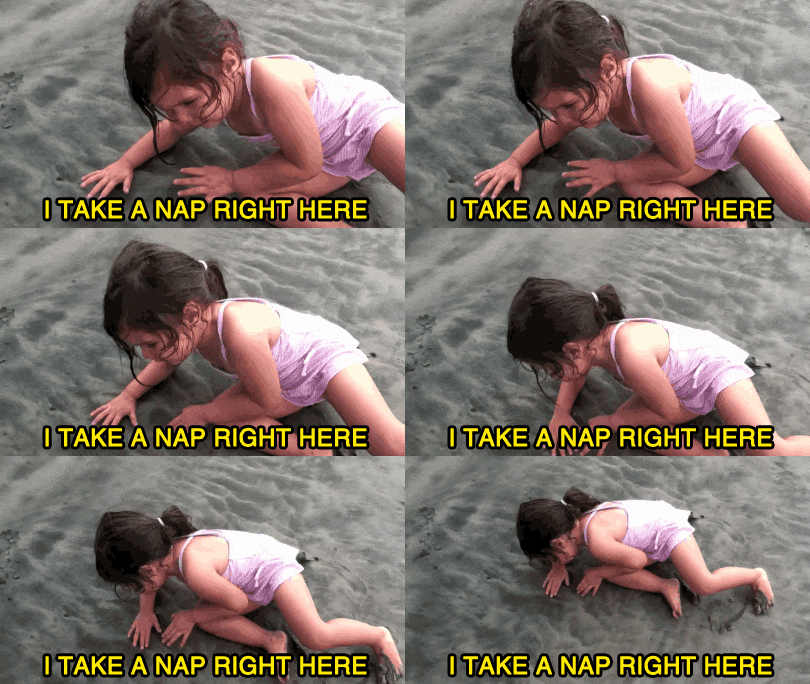
girl beach kid tired sleepy

Good days and bad days. Tired days. Lots of tired these days.

Thursday, October 15, 2015

Descending the mountain.

Last weekend I visited my brother and his family for Thanksgiving. Before dinner, my brother mentioned going to a local provincial park and getting some air. They run their ski-lifts during the fall, carting tourists up the mountain to enjoy the view and the fall colours.

We headed there a little after noon, my mother, my brother, sister-in-law, and the two kids. It was a slow, awkward ride up, the sun glaring directly into the faces of those being pulled up the mountain. Every once in a while someone would drop a backpack and the ride would slow down, hold a few minutes and then sputter back to life.

After twenty minutes or so we were at the top of the mountain. The views were indeed beautiful. There was a light fog in the distance, so we couldn't see the city. We could make out nearby towns. We could see the red and orange of the fall colours, and neighbouring farmlands stretched between smaller hills. Different fields patterned different, creating a patchwork of crops in varying shades of rust.

I find it difficult to enjoy natural spaces when they're crowded. The top of the mountain seemed too small, and poorly planned. No doubt skiing was the main attraction, the walking trails and pedestrian facilities were lacking.  Folks mashed together near the edges of the mountaintop, looking outward. I tried finding a quiet spot, but every space has huddles groups and bickering families.

"Why are there so many Chinese people?" asked my 5-year-old nephew.
"Maybe there isn't as much of a season change wherever they're from so they're here to look at the colours," I tried to answer.
"Where are they from?" he asked.

I stopped myself from instinctively replying "China" since folks with Chinese ancestry could be born anywhere.

"Well, they could be from China, or from here. People can be born anywhere. I don't know." My answer didn't satisfy him, really. He ran off after his brother, no doubt not really caring about the complexities of his question. It bothered me. I wanted to express to him that nationality is a construct and that we should try and avoid assuming anything about anyone. He's five though, and I didn't have the energy.

The kids soon became a bit much for me, so I tried to step away and get some quiet, and maybe some literal perspective as well. I made my way to a wooden bench and sat facing an over-tall safety railing. It looked like a high wooden fence, similar to what you'd see around a backyard, only the horizontal planks were over a foot apart. It seemed to have been intended as a safety gate, when really all it was to me was an obstruction to a view.

I thought about scope. How untethered any of us could be, if so inclined. Here are these tourists. Chinese. Italian. Japanese. All from such different places, so far away from this hilltop. What if I got on a plane, and left? What if I went to their local hilltops?

It just seemed like for a moment I understood opportunity in a broad sense. That things could be left. Other things could be picked up. Choices could be made, in ways I maybe couldn't even really comprehend. My frame of reference is small. My understanding of what is possible is smaller.

Lives can be lived in between choices. Lives are lived in wholly intentional, present ways. This is a think people do. Other people. Not me.

I could leave. I could pay off the little debt I have and then just save up. Sure, right now I think those savings are meant for a downpayment and owning my own little place. But it doesn't have to be that way. I could move. I could live a different life. I could attempt an adventure. I could retreat from this modern life and commit to a hermitage. I could do something. 

So much of projecting into the future involves things we know about ourselves. I am this way. I like these things. I don't like him. I appreciate her. I need certain things. I have limitations. How much of that patterned thinking becomes a habit of limits?

I could stand to be looser. There is no doubt an easiness to being able to feel something, and think something, and not overly identify with it. To visit it, think on it, and then let it go.

So much of my human experience has been spent worrying. Anxious. Depressed. Feeling unfit. Feeling stunted. Feeling like I need to accomplish a certain attainment, or get to a place where I feel fully formed before I can really be of value to another.

I feel this way socially, romantically and also creatively. Notions of success.

All of these hard-defined levels. These goal posts. These mile markers.

So little of it has real value. Weighing value itself is a god-damn riddle.

Perspective is easier on a mountain top.

Thursday, October 1, 2015

Pavana पवन.

I've been knocked on my ass by the work and words of Pavana पवन. Initially saw her words on Ayesha Siddiqi's Tumblr, I googled the name and didn't find very much. I followed the source link and found the original master-post, but I had assumed this was a published author, that these were words that were older, and an established part of the canon.

I'm just blown away. Check out Pavana's site, Maza-Dohta dot com.
“I believe pain breeds wolves
and joys give rise to moons.

We grow forests in our bones
so our memories can’t find us.
I believe we hide and haunt ourselves”


― Pavana पवन
This is almost the exact wording to express the tattoos on my body. 
“Since the age of nine, I have felt an unbearable heaviness in my soul, an unpronounceable ache for a different time and place. I feel for things that have nothing to do with me, for budding flowers caught in the rain, for petals lost to the wind. I know what the earth must feel like, the way it serves as both the coffin and the womb for new life. I feel its heavy, heavy weight of loss, as if with every passing year I am both ending and beginning. Perhaps this is what growing up is, and perhaps some of us must die, over and over, before we are born again. Since the age of nine, I have been buried beneath my soul, and I believe I am beginning to bud again, like a strange flower grown from its own decay. I am in bloom, I have always been in bloom, and I am now just learning my own name. ” 
— In Bloom || Pavana पवन
A testament to maturity, and feeling the immovability of womanhood. I can relate to the feeling of a certain certitude of self, but the deep wound I walk with, never leaves me.
“
I am half a moon
where I once held
a heart.

I am not
broken,
I am simply
coming back
to myself.
”
— Pavana पवन
It's the hope I hold - that that's my direction.
“
love yourself.
this is how
we become
lovers.
”

— Pavana पवन
I have my work cut out for me. 
“
‘What should I
look for in
a man?’
 
The woman in him.
Search for her.
”
— Pavana पवन
The loves of my life are the friends I have, I have had, and I will make. There is no love like that of a woman. The selfless. The giving. The empathy. The nature of the feminine in its maternal roots. I am not a mother. I will never be a mother. I reject that role. But there are parts of me that have that unquestioned reactive caring. If we're gendered to have certain roles, certain strengths, certain values to be valued, the feminine is it.
“We age not by years, but by stories.” 
— Pavana पवन
A story can age you terribly. A light-hearted nature can keep you young. You're an old soul, they said. Maybe that's why I'm so tired.

Check out the words. No doubt better read without my reactions.