Showing posts with label self-care. Show all posts

Wednesday, February 22, 2017

Organizing our way through mental illness.

McGill Daily has a piece up called Organizing our way through mental illness by Saima Desai.

The piece works through the links between mental illness and working in social justice/caring about social justice.

Desai quotes a Baffler article by Laurie Penny:
The isolating ideology of wellness works against this sort of social change in two important ways. First, it persuades all us that if we are sick, sad, and exhausted, the problem isn’t one of economics. There is no structural imbalance, according to this view—there is only individual maladaption, requiring an individual response. The lexis of abuse and gas-lighting is appropriate here: if you are miserable or angry because your life is a constant struggle against privation or prejudice, the problem is always and only with you. Society is not mad, or messed up: you are.
It's can be difficult to balance self-criticism with real, lived oppressions and limits. When discussing "the secret" of self-realization:
It would be nice to believe that all it takes to change your life is to repeat some affirmations and buy a planner, just as it was once comforting for many of us to trust that the hardships of this plane of existence would be rewarded by an eternity of bliss in heaven. There is a reason that the rituals of wellbeing and self-care are followed with the precision of a cult (do this and you will be saved; do this and you will be safe): It is a practice of faith. It’s worth remembering that Marx’s description of religion as the opiate of the masses is often misinterpreted—opium, at the time when Marx was writing, was not just known as an addictive drug, but as a painkiller, a solace when the work of survival became unbearable.
I find the language of it all odd. How "self-care" has been politicized, when really it existed before it was a headline. It was justing taking care of yourself. Or resting. Or taking a fucking break. I understand it as a political act, in the way in which it's used to describe consciously prioritizing taking care of yourself since the world is brutal and not kind. Penny herself ends with the Audre Lorde quote, "“is not self-indulgence—it is self-preservation, and that is an act of political warfare.”
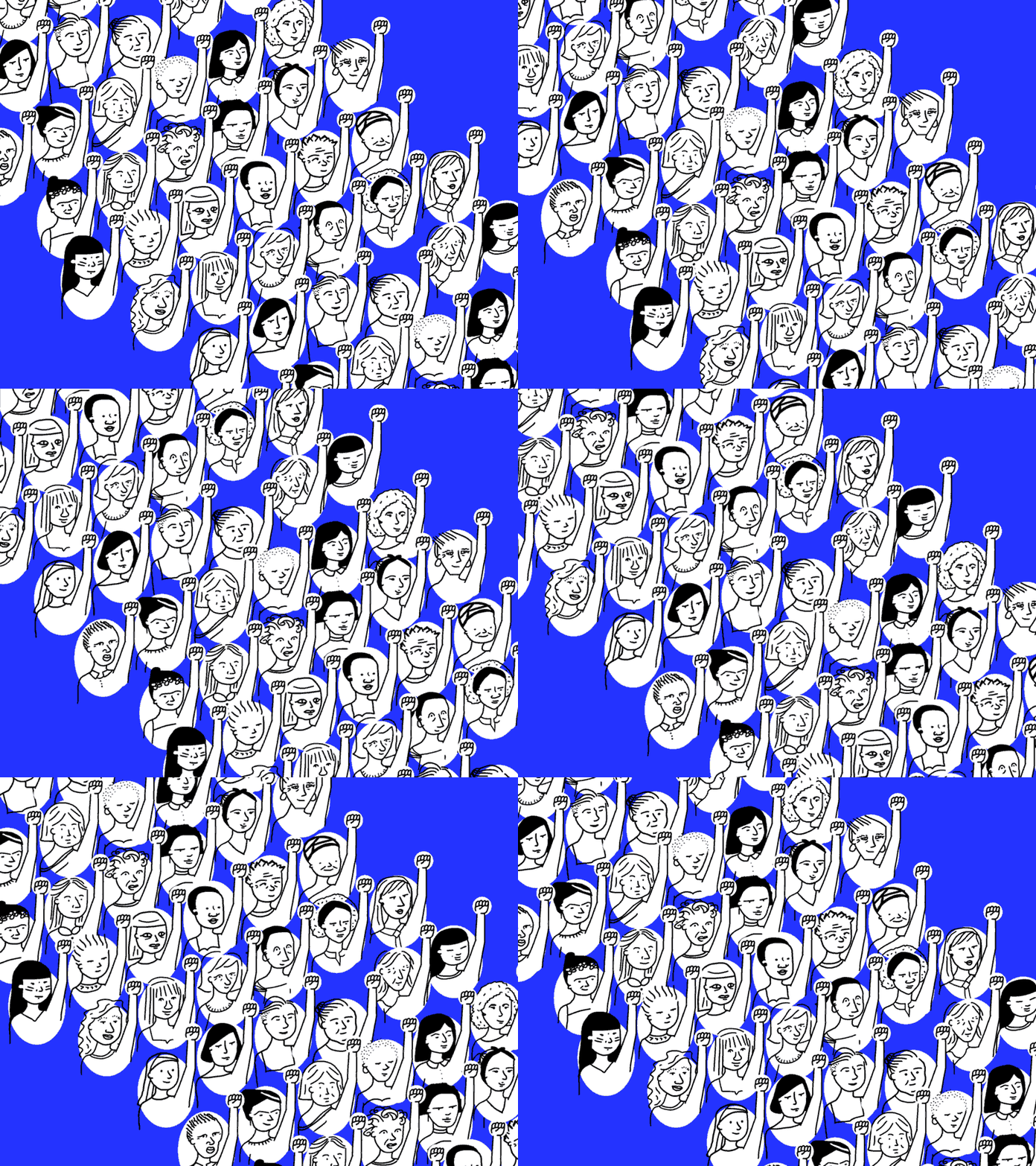
Laura Salaberry feminism march feminist protest

We gotta take care of our minds and bodies in order to resist.

Recommended reads:

Life-Hacks of the Poor and Aimless by Laurie Penny

Organizing our way through mental illness by Saima Desai


Wednesday, January 11, 2017

Emotional identify and emotional inheritance.

From The Book of Life, on emotional identity:
... Emotional Identity, the characteristic way in which our desires and fears manifest themselves and our personalities respond to the behaviour, negative and positive, of others. There are four main themes around which our Emotional Identities are structured and it is their particular dosage and arrangement within us that decisively shapes who we are. To get to know ourselves is – in large part – a question of coming to understanding the configuration of our Emotional Identity.
Those four main themes are listed as self-love, candour, communication and trust.

For me, reading the self-love section is prickly, since I know how it's a very difficult subject for me. The page includes a simple test - and I clearly have a very high score for "lack of" self-love.

The chapter also discusses what it calls Emotional Inheritance:
What creates Emotional Identity? Why do we have the emotional identity we do and not a different one?
 A big modern response looks to genetics. We’ve got a specific genetic inheritance and (via many complex processes) this inheritance shapes our adult personality. We’re not saying genetics are irrelevant. But we want to focus attention on another kind of inheritance: Emotional Inheritance.
Developed mainly in early childhood, it plays a major role in our most basic character traits:
Psychotherapists have developed a special term to capture what we inherit emotionally from the past: they call it our ‘transference’. In their view, each of us is constantly at risk of ‘transferring’ patterns of behaviour and feeling from the past to a present that doesn’t realistically call for it. We feel a need to punish people who aren’t to blame; we worry about a humiliation which isn’t anywhere on the cards; we’re compelled to betray as we were once, three decades before, betrayed.
So how do we navigate knowing what we're pre-disposed to?
Maturity involves accepting with good grace that we are, of course, involved in multiple transferences, along with a commitment to try rationally to disentangle them. The job of growing up means realising with due humility the exaggerated dynamics we may constantly be bringing to situations and to monitor ourselves more accurately and more critically so as to improve our capacity to judge and act in the here and now with greater fairness and neutrality. We need to see how the people and situations in our past that have given rise to habits of mind that lead us to see current events in particular ways. The idea is to grow a little wiser as to where our troubles are coming from and around what areas of our lives we will therefore need to be especially careful.
Lastly, three benefits are listed as being the result of this type of self-reflection:
Firstly, we become aware of ways in which we are a bit crazy (that is: puzzling to others and inappropriate in our responses). We can catch ourselves before we do too much damage. But we also grasp why we are like this. We don’t have to hate ourselves, we can become more sympathetic to the way we’ve had some awkward legacies – and have learnt a few somewhat counterproductive ways of coping.
Secondly, we can more calmly explain ourselves to others. Even if we can’t entirely change, we can flag up what might be challenging about living around us. If we understand ourselves better we can help others understand us more sympathetically too. 
Thirdly, we begin to see that we have a degree of freedom and opportunity to change (to a limited but useful degree) the difficult parts of who we are. We don’t have to keep on repeating exactly what we’ve been doing. There are other options.
A worthy read, a lot to unpack.

Wednesday, August 10, 2016

Hunger makes me.

I love Jenny Slate. Every single thing I've seen her guest on, I've loved her in (Parks & Rec, Kroll Show, House of Lies, Drunk History) and I adored Obvious Child. I follow her on twitter and just think her friendship with fellow-comedian Gabe Liedman is "goals." A while ago she, and a few other female comedians I follow linked to an article by Jess Zimmerman called Hunger Makes Me. I've finally found the time to read it.
The piece is great, and you should read it in its entirety.

Though hunger, as discussed by Zimmerman is definitely gendered, a lot of what she talks about could apply to anyone, especially when it comes to being hungry for something.

Hunger, the desire for something, the quiet need, the gnawing, all of it is deeply existential and humanist. The ways in which all of it is internalized, it also seeps out.
Fearing hunger, fearing the loss of control that tips hunger into voraciousness, means fearing asking for anything: nourishment, attention, kindness, consideration, respect. Love, of course, and the manifestations of love. It means being so unwilling to seem “high-maintenance” that we pretend we do not need to be maintained. And eventually, it means losing the ability to recognise what it takes to maintain a self, a heart, a life.
Take it from me - someone who has been celibate due to being traumatised - who is fearful, parts of me shut down. They shut down to just move on and get through the day. It was too much, I was overwhelmed, and it needed to disintegrate over time. I need the tools, I needed the time.

As things get better for me, I can identify the damage. I can see the work I have left to do. It's a lot. It can be overwhelming. On a bad day, I feel like a loser, a pariah, a romantically retarded, socially stunted troll person. On a good day, I think that things change and evolve, and love and care can be both crafted and found.
Women talk ourselves into needing less, because we’re not supposed to want more—or because we know we won’t get more, and we don’t want to feel unsatisfied. We reduce our needs for food, for space, for respect, for help, for love and affection, for being noticed, according to what we think we’re allowed to have. Sometimes we tell ourselves that we can live without it, even that we don’t want it. But it’s not that we don’t want more. It’s that we don’t want to be seen asking for it. And when it comes to romance, women always, always need to ask.
Feeling unsatisfied is a big one. I think it points to the amount of dissapointment we have to deal with as women.

The last few months I've been thinking about what it is I want. What kind of job and lifestyle? What kind of home? What kind of priorities? These are really heavy questions when your default setting is to minimise what you want and move on to other things.

Romance for me is a non-sequitur right now. Celibacy has been the norm, and I still have a lot of work to do when it comes to self-love and my body. But, I can still relate to everything Zimmerman says, because I'm her "before".

Read the piece! Share it with your friends!

Wednesday, July 13, 2016

Life-Hacks of the Poor and Aimless by Laurie Penny.

Please read Life-Hacks of the Poor and Aimless by Laurie Penny.
The isolating ideology of wellness works against this sort of social change in two important ways. First, it persuades all us that if we are sick, sad, and exhausted, the problem isn’t one of economics. There is no structural imbalance, according to this view—there is only individual maladaption, requiring an individual response. The lexis of abuse and gas-lighting is appropriate here: if you are miserable or angry because your life is a constant struggle against privation or prejudice, the problem is always and only with you. Society is not mad, or messed up: you are.
... 
 When modernity teaches us to loathe ourselves and then sells us quick fixes for despair, we can be forgiven for balking at the cash register. Anxious millennials now seem to have a choice between desperate narcissism and crushing misery. Which is better? The question is not rhetorical. On the one hand, Instagram happiness gurus make me want to drown myself in a kale smoothie. On the other, I’m sick and tired of seeing the most brilliant people I know, the fighters and artists and mad radical thinkers whose lives’ work might actually improve the world, treat themselves and each other in ludicrously awful ways with the excuse, implicit or explicit, that any other approach to life is counterrevolutionary.  
...
The harder, duller work of self-care is about the everyday, impossible effort of getting up and getting through your life in a world that would prefer you cowed and compliant. A world whose abusive logic wants you to see no structural problems, but only problems with yourself, or with those more marginalized and vulnerable than you are. Real love, the kind that soothes and lasts, is not a feeling, but a verb, an action. It’s about what you do for another person over the course of days and weeks and years, the work put in to care and cathexis. That’s the kind of love we’re terribly bad at giving ourselves, especially on the left.
Great read. Check it out.

Monday, April 25, 2016

Trust.

I watched Super Soul Sunday yesterday, which featured Iyanla Vanzant. She was promoting her new book, which is all about Trust. Although I like Vanzant sometimes, her experience is very God-centered, and it sometimes alienates me. There was however, a quote from the episode that poked me right in the guts.
There is no greater battle in life than the battle between the parts of you that want to be healed and the parts of you that are comfortable and content remaining broken.
Snap!

There's a lot to un-pack here.

First, the comfort of what is known, and what is habit. There is absolute comfort in things remaining the same, or as constant as possible. I am a creature of habit, I could do the same thing weekly, on rotation, and be reasonably content. There's also comfort in habit and in minimizing surprises or discomfort.

My friend E and I were talking about someone who has a "victim mentality" and who often re-frames situations to always revolve around her, and on top of that, inconvenience or hurt her in some way. For E, it took years for a pattern to make itself visible. After a while she realized that her friend was always at the centre of the drama, and seemed to stoke that drama when and where she could. We talked about it, and it became increasingly clear it's a large part of her (self prescribed) identity and that she get a lot out of it. She wanted to re-centre herself. But it's also part of how she lives, and how she has lived for over 30 years.

In her case, she seems to invigorated by being put-upon. Are she and I alike? Do I see the things that bind me to habit? Do I see my triggers?

What do I get out of identifying with my illness?

How is it certain memories can completely drag you into a remembered shame or pain?

Why is it so difficult to let go of?

What do I get out of the safety of isolation?

What does my lack of trust for the male sex really mean for me? It means loneliness, doesn't it? I'm attracted to heterosexual males, unfortunately for me, that's a group that I have a lot of distrust for. I guess there's also safety in shutting down that conversation, or possibility before anything ever happens. There is zero room for rejection, since I do not put myself in situations in which I can be rejected.

I can't be rejected if I don't even show up.

Thursday, February 25, 2016

The Process Of Getting Better Can Really Suck.

Turns out today is a Katie Klabusich day.

I had put aside The Process Of Getting Better Can Really Suck by Katie Klabusich because I knew I wanted to give it my full attention.

I just really relate to much of Katie's experience:
The reason is simple: I will fucking lose it if I don’t acknowledge out loud that some things inherently suck. Figuring out what kind of care you need, accessing said care, and getting that care is exhausting. And at the point of getting care, you are literally just getting started. Yes, there’s some relief at having survived the no-help-available portion of the ordeal, but you haven’t actually started unpacking or treating anything yet. And, well, that sucks. 
And in fact, many things about the process of getting to where I am right now—seeking second-line treatment 17 months after beginning a care plan—sucked quite a bit.
I mean, isn't what this blog has been about? Sure, it's been an exercise in writing, and in combating my internalised nature, but it's also been about the frustration of it. How many doctors have I seen? How many free services have I tried to access? How many of those experiences were total shit shows?

Before having a family doctor, I had to tell my story, over and over again. New doctors. New therapists. New counsellors. Some eager to help. Most over-worked and seemingly zoned-out. It seems like writing it out seemed like a helpful exercise if not a logical tool. I'm not the greatest when it comes to memory. I don't remember most of my 20's. If that's continues to be my case, at least I'll have some kind of written record.

It can be easily forgotten, all of the work I've done. All I have to do is click on the access label and I'm quickly wincing/remembering it all.

Lately, a lot of my worry has been around work, money, job stability and my lack of ambition. She touches on that too, since working to live also means asking yourself if you can afford the downtime, or the therapy, or that possibly helpful class or workshop. How about rent? Groceries? A fucking bus pass?

Yes, things have been better. My medication is better. I have a family doctor.

I am however, still living pay-check to pay-check, and do not have a therapist.

It is so much work, it is exhausting, and it does really fucking suck sometimes. There's power in allowing yourself to say that out loud, and also allowing those you know who are in pain to say it too. 

Tuesday, November 24, 2015

The value of "mental health days."

sick flu cartoon adventure time cartoon network

Check out A Call For Sick Days To End Mental Health Stigma over at The Establishment.

Author Katie Klabusich lives with Dysthymia, anxiety and ADHD. She and I seem to have a similar experience, in that we've only recently been able to seek proper medical treatment in our 30's: 
So that’s what I have: a low-grade, persistent depression that rears its head now and again. I don’t really think about it much. I maybe have five to 10 total days a year where I’m affected by this particular issue—it’s hard for me to be precise because I’ve only had treatment for any of this north-of-the-neck stuff for about a year (#ThanksObama) and it’s all affected by life circumstances as well as brain chemistry. That’s part of the fun—mental illness is mostly unpredictable, even if it’s the sort that can be mitigated.
Mental illness often lives in an unpredictable space yes, but the way it continues to inform your decisions in a "what if?" "better be safe than sorry" takes shape in the form of self-diagnosed limitations and worst case scenario planning.

In Klabusich's case, she talks about the struggle of taking a sick day when overwhelmingly exhausted. Like many in the creative field, she finds it very difficult to feel validated in taking time off, and her working freelance makes that even more difficult, since there is no real structure to support that right.

Often with mental illness, it's difficult to describe the physical toll - often akin to a flu or exhaustion - that we deal with.


After I posted about my sick day, supportive comments rolled in across social media. Some from family and friends who deal with illnesses of their own and appreciated my making a point of not just taking a sick day, but describing it as such. It felt warm and validating, like a fuzzy blanket, as I rightfully gave my body a break. 
Then I caught a comment congratulating me for exercising “self care” and was jarred awake. 
Self care—while an extremely important part of activism, working for yourself, and any profession that requires you do emotional work—had nothing to do with my sick day. It felt condescending and incorrect. I had an actual physical response to seeing the words.
Wine is self care. Reading a book is self care. Hiking in nature is self care. A massage is definitely self care.
 
Me spending the majority of a 48-hour stretch in bed unable to function? That’s not self care. That’s called being sick.
This.
And when you call it self care, you’re downgrading what I’m going through to a level you are comfortable with. Because you aren’t comfortable picturing me with a mental illness. That’s your issue and I don’t appreciate having it projected onto me. I am not here to make you feel comfortable with my illness.
...

When you mischaracterize what I’m going through for your comfort, you are absolutely invalidating the work I do every day to get well AND asking me to do the additional emotional labor of hiding my illness so you don’t get any of it on you. People who deal with chronic illness, long-term poverty, or both already do a massive amount of that labor to keep things hidden—not necessarily for their own comfort, but for yours. Asking more of them is greedy. So stop it.
 
Now, lest I be misunderstood . . . yes, OF COURSE, people with chronic conditions need to exercise self care. We should do SO MUCH of it. Like every day. It should be on our calendars like required tasks. 
Here’s the difference: it’s something we should be doing to prevent sick days.
I seem to basically be quoting the entire article. Please see the original.

I struggle with sick days. I have no problem taking them when I'm physically ill. If I have a stomach flue or a throat infection, I feel I'm justified and that I can easily prove my illness.

sick

With mental illness I often feel I need to lie. I say it's a stomach flu or food poisoning. First, my office doesn't have sound HR policies, or anyone at work I feel safe speaking honestly to. There are also very vague sick-day policies. There isn't more generalized language, like "personal day" - which is used in some professions. Second, I'm afraid these things could be used against me. If I take a "mental health" day 6 times a year, well that's 6 times more than someone who isn't mentally ill.

It's difficult. My sensitivity/self-esteem around my mental illness coupled with my shitty work experiences still leave me worried about being fired. Which then plays into my fears regarding my ability to take care of myself.

Klabusich's article proudly says how hard it is, but that she's taking care of herself, and that's to be commended. I agree. I just don't feel the HR policies are in place to assist that, and that work-culture still has a long way to go.

It's added work. It's taking care of yourself, plus navigating a system that doesn't take you and what you need into consideration.

Tuesday, November 10, 2015

Dogs as an antidepressant.


Julie Barton has a new book out on her relationship with her dog, called Dog Medicine. It's a memoir about her golden retriever Bunker, and how he acted like a a therapy/aid dog and helped her survive her depression.

She also did a short Q&A about the book over on The Daily Dose.

This is a bitter-sweet read for me, I love hearing about the non-medicalized ways we can seek soothing and comfort, but I want a dog so badly, and I miss having one in my life so much, that reading about having one bums me out.


I can't get a dog unless I work closer to home and can go home for lunch, or, I eventually have a partner I co-habitate with, who shares the responsibility with me. And, I don't know if that's ever going to happen - it could never happen. And that bums me out out out.

I think having a pet-friend is a big responsibility, and stories of them being locked-up all day, or returned/abandoned make me furious. So, I take everything into consideration when thinking of adoption, and that's why I don't have a dog. I don't want it to be alone over 8 hours a day.  

dog dogs panda dog s cute animals

Maybe if I end up in a condo building the allows animals, I can walk and dog-sit for neighbours. That would be a happy alternative, that would at least quench my dog urges.

I mean, I notice dogs the way creeps notice a pretty woman. I make eye contact them immediately, more so than I ever have with any other living thing. I talk to them. I want them to walk by me. I like asking them questions I know they can't answer. I want to know their names. If they ignore me it's devastating.

I sometimes babysit my brother's dog and when he leaves, I definitely feel the difference. I don't take him to the dog park. I can't cuddle him at night. I can't pet him while watching a program on TV. If I drop food on the floor, I have to pick it up (the worst).


It wouldn't be so bad if I had dogs around I could help out with, but my friend C moved to Victoria with her dog, and my one friend left with a dog lost it in a recent divorce, and I sometimes feel like I'm the one who is the most upset about the loss. So here I am, I don't even have a proximity dog.

The BarkPost  love animated cute dog

I pulled a few Barton quotes that sum it up well for me:
For me, the fact that I didn’t have to pretend or explain myself around my dog was the most incredible gift. A dog never asks “Why?” I could be as sad as I wanted to be around Bunker and he didn’t care. He just accepted me. 
That's true. Though when I was very depressed and a dog owner, I often felt guilty about not taking the dog out. She'd sometimes look at me and sigh, which was, well, brutal.
I could be a complete sobbing mess and my dog would calmly sit with me, maybe roll over and ask for a belly rub, maybe bump his big butt on mine. All of those actions always felt like a, “Hey, I’m here. Just so you know."
 From what I understand, golden retrievers are magical dogs made of pure light.
And then there are the things we can’t explain, like when we’re in a room alone, feeling bad, and the dog is all the way across the house, but he still comes trotting down the hallway and peeks his head around the door, his eyebrows, so concerned, say, “Person? You ok? Did you forget that I love you?”
That's the good stuff. That a dogs' needs are simple enough, and that they align with a basic schedule of taking care of yourself. Food. Walk. Fresh Air. Maybe some play. Some cuddles. A friend.

The BarkPost  cute dog food adorable

I miss having a little furry friend.

I contacted a local animal shelter about walking their dogs, but they seem to be over-run by volunteers of that kind.

For now I'm just going to be a dog-creep I guess.

funny dog funny puppy funny animals cute

Friday, August 28, 2015

I can't sleep on a treadmill.

I'm trying to figure out an exercise routine I can commit to with my schedule / exhaustion. I'm so so tired, thinking about it just seems impossible. I also have to think about budget, location (if it's a class or gym) and where I would go. I understand the need to exercise, and I miss it, I really do. I'm just so tired.

Little animation experiment. All of the pigeons in this city are SO chubby, I am amazed they can fly at all.

This is pretty much me right now. I'm getting sleepy , just thinking about it. I want to rest as much as I can this weekend.

I’ve been feeling a bit MELONcholy lately… heh.

The great gif illustrations are by Sydni Gregg's Comfort Zone. The above one is called melon-choly.

Thursday, August 6, 2015

Working on body positivity.

In yesterday's session with Ranjana, she tasked me with body positivity homework. She'd like me to take the time to look at myself in the mirror and say kind things about my body, and about my face. She said that when I lie down in bed at night, I should think about my body, how it feels and what I like about it, and also what I want.

Often going to bed at night is when I feel loneliest. I miss affection. I miss being liked be someone. I miss being someone's favourite person. It's just so sweet.

So, body positivity is my homework. It's going to be difficult. I have a lot of negative associations to my weight gain. I also feel like I "fucked up" my body, which I have in a lot of ways.

But I am lonely, and the way I feel about myself is a big part of my isolation and inability to engage anyone romantically, so I have to try.

A big problem for me, is that when I get depressed I completely internalize and detach from my life, and my body. Hopefully working on appreciating my body and practising being grounded in it will help me take better care of it and myself.

I don't mind being round. I've always been curvy. I'll be shaped like an hour-glass no matter what. I do not want to be so overweight that it limits my ability to socialize though. Being fat means "being fat" everywhere. Fat on an air plane. Fat on a bus. Fat going up several flights of stairs. Fat trying to sit in a weird stool. Fat in tiny movie seats. Fat at the theatre. It's in these spaces that I am conscious of whether or not I literally fit in.

It's also a question of being comfortable in movement. I want to be able to take exercise classes in order to help myself stay healthy. I want to be able to move with relative ease.

It's hard. I'm not saying all sorts of bodies aren't beautiful. They are. But my own body has seen such little positive reinforcement, it's a habit that might not feel genuine at first.

How can I expect anyone to be attracted to me, if I can't see it myself?

I guess ultimately this is the goal:


Illustration by MooseKleenex.

Also, this one made me laugh:


More sweet gifs by chibird!

And they should be treated like serious problems, because mental illnesses won’t just “go away” without proper help.


We could all use a little more self love. <3 It’s 2015, let’s give it a try.


You can’t be happy all the time, and that’s okay.


If someone’s just feeling down, it’s great to try to cheer them up! But then there’s a different kind of sadness which is harder to get rid of, and then as a friend you just have to be understanding.  


Random hug! ^u^ Was excited to find out that my pocket penguin was on tumblr radar yesterday, hello everyone new (and hugs to everyone old)~


Aw, this is not a very optimistic picture. Hopefully I’ll be able to draw something more cheerful tomorrow, but busy studying for midterms. ^^;;


I feel like it’s just human nature to think and over-think things. >^<


All by Jacqueline, AKA chibird!